Search the archive.
Find published work and reporting by title, description, article text or tag.
Refine results1
Also searching for Space, because “rocket” is another name for it.
24 results for “rocket”.
- Showcase
Semantic Globe: A WebGPU Earth That Understands Plain English
Type a vibe like "somewhere cold and lonely" and watch a 3D Earth pin the answer. The text embeddings and the planet shaders share one GPU in one browser tab, no server in the loop. Joshua Lochner's quiet flex of what WebGPU can do when nobody is looking.
- Showcase
False Earth: A GPU-Driven Procedural Planet Built with WebGPU, TSL, and Three.js
An astronaut walks an alien planet that responds to every step. Over 1M grass blades, procedural terrain, and VAT-animated roses, all running in the browser via WebGPU compute shaders, TSL, and React Three Fiber.
- Showcase
Edolus Turns AI Infrastructure Into a Cinematic WebGL Journey
Edolus moves from orbital satellites and desert-scale systems into glowing data flows, using PlayCanvas, WebGL, custom GLSL, and evolving sound to turn AI infrastructure into a cinematic journey.
- Showcase
BlueYard: A Two-Color WebGL Atlas by Unseen Studio
Unseen Studio rebuilt BlueYard around Buckminster Fuller, a fluid-simulated orb, and a beautiful color palette. Three.js under the hood, reactive cursor, four thematic zones to scroll through. Worth opening devtools on.
- Showcase
DRIFT: A Million Particles, a Lost Astronaut, and AI-Generated Loneliness
A lost astronaut records his diary in your browser. Over a million GPGPU particles shift with his mental state while AI generates fresh text and voice each visit. Ming Jyun Hung built something that feels alive and a little heartbreaking.
- Showcase
Penderecki's Garden: A Point-Cloud Memorial Built Using Photogrammetry
Huncwot turned billions of drone-captured particles into a navigable WebGL garden for composer Krzysztof Penderecki. Custom GLSL shaders breathe with the music. Fully keyboard-accessible. One of the most ambitious Three.js projects we've seen.
- Showcase
Gen-02 Portfolio: An Immersive World
Samsy transforms the traditional portfolio into a 3D navigable space with his Gen-02 site. Built with Vue.js, GSAP, and custom WebGL, visitors explore interactive rooms showcasing a decade of award-winning creative tech work. Awwwards SOTD winner with serious technical depth.
- Showcase
Messenger
Messenger is a beautifully crafted WebGL delivery game. Set on a tiny cel-shaded planet, it runs flawlessly across browsers. Explore the charming world, complete deliveries, and discover hidden surprises.
- Showcase
LFM2-MoE: An 8.3B Parameter Language Model Running Entirely in Your Browser via WebGPU
Liquid AI's LFM2-MoE loads 8.3B parameters (1.5B active) and generates text client-side through WebGPU. No server, no API key. A hybrid convolution-attention architecture running Mixture-of-Experts inference in a browser tab, powered by Transformers.js.
- Showcase
WebHeat: GPU-Powered Thermal Simulation for Any STL File
A high school senior learned Newton's law of cooling in class, then built a full thermal simulation in the browser. Drop in any STL, watch heat propagate through voxelized geometry on the GPU. WebGPU compute shaders, React frontend, and a useRef trick that keeps it all from falling apart.
- Showcase
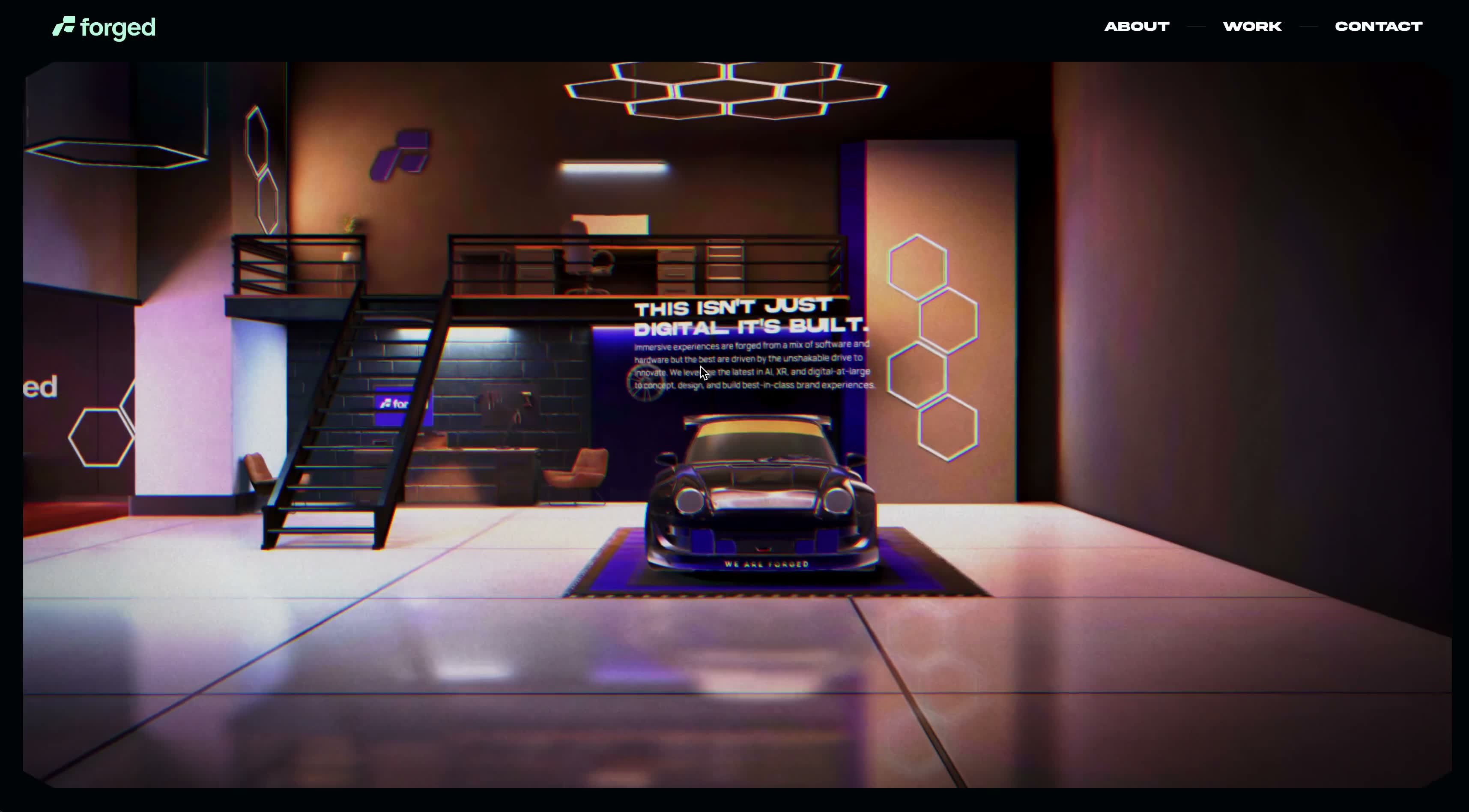
Forged.build
Forged.build turns a studio site into a cinematic 3D workshop built in WebGPU. Scroll through a real-time space with baked GI, dynamic highlights, and custom shaders. Built by Michael Modena to show what a small team can do with modern web graphics.
- Showcase
A Project Gallery That Bends Like Film
A row of project cards behaves like a strip of film you can scroll, flex, and shove around with your cursor. Built in Three.js with hand-written GLSL, where scroll velocity drives a vertex-shader bend and a post-process pass adds the grainy, almost celluloid edge shimmer.
- Showcase
BND Agency: An Agency Portfolio Built as a Showroom
Doan Bao Nam rebuilt the agency portfolio as a showroom you move through, not a page you scroll. Interactive 3D canvases and a custom audio-visual engine share a single frame, holding 60 FPS while sound and geometry run at once. Open devtools and watch how it stays steady.
- Showcase
Gaussian Splats on a Revit Model in 600 Lines of JavaScript
Michael Beale's gaussian-splats-lmv overlays photoreal XGRIDS captures onto a Revit model inside the APS Viewer. Same camera, same section planes. Three modules, roughly 600 lines of JS, a 65,536-bucket counting sort in a Web Worker, and 32-byte splat records doing the heavy lifting.
- Showcase
Interactive 3D Sony Headphones Built with Spline and Webflow
Lorenz Wieseke built a product page that actually earns your attention. Particle environments, animated audio wave rings, swappable colors, and convincing materials, all orchestrated through Spline and Webflow without a custom WebGL pipeline in sight.
- Showcase
In The Clouds: Tallest Buildings as 40-Meter Blocks
The world's tallest buildings rendered as stacked 40-meter blocks in Three.js. One block equals four floors. Pure client-side WebGL with procedural geometry. No map tiles, just height data and math.
- Showcase
Game of 3D Life: Conway's Cellular Automaton with WebGPU
Conway's Game of Life in three dimensions. Simulation and rendering both run on the GPU via WebGPU compute shaders. No frameworks, just vanilla JS and hundreds of thousands of instanced cubes. Fly through the clusters as they evolve.
- Showcase
WebGPU Water Simulation: Porting a Piece of Graphics History
The 2011 demo that helped inspire Figma gets a WebGPU rewrite. Ripples, caustics, raytraced reflections, and a bobbing sphere, all running on modern GPU APIs. Yong Su's port is a case study in what it takes to cross the WebGL-to-WebGPU bridge.
- Showcase
Laser Drift: A Synthwave Arcade Shooter Built in Three.js
Lowpoly spacecraft, neon grids, and custom shaders combine in this browser-based arcade game. Gesture controls on mobile, no UI clutter, and a commitment to retro aesthetics that goes deeper than a bloom filter.
- Showcase
NGL Viewer: WebGL Molecular Graphics That Scales to Millions of Atoms
A WebGL viewer that renders proteins, DNA, and virus capsids with millions of atoms, smoothly, on desktop or phone. Hyperball shaders, MMTF parsing, and a selection language that actually works.
- Showcase
Deferred Rendering in WebGPU: Sponza with 400+ Compute-Driven Point Lights
Georgi Nikolov's WebGPU renderer puts 400+ point lights in the classic Sponza atrium. Deferred shading, cascaded shadows, Hi-Z reflections, TAA. Clean architecture that handles WebGPU's explicit pipelines without drama.
- Showcase
Studio Lumio: A Monochrome Portfolio
A designer-developer duo's portfolio that knows when to stop. Smooth GSAP transitions, cursor-reactive layouts, and shaders that punctuate rather than shout. Next.js, Lenis, Zustand, and an open-source hooks repo worth bookmarking.
- Showcase
Prinzipiell Tinker Series
Frank Reitberger’s Tinker series is a collection of WebGL and WebGPU experiments exploring procedural geometry, modular shaders, and real-time rendering in the browser. Each project builds on the last, offering sharp techniques and inspiration for anyone working with Three.js or TSL.
- Showcase
The Monolith Project
The Monolith Project is a cinematic WebGL journey built with React Three Fiber. It weaves together modular shaders, layered particle systems, and a custom deferred renderer into a scroll-driven story that flows like a film. Every effect is modular. Every transition feels intentional.