Search the archive.
Find published work and reporting by title, description, article text or tag.
Refine results2
Also searching for Maps & Geography, because “map” is another name for it.
14 results for “map”.
- Showcase
Semantic Globe: A WebGPU Earth That Understands Plain English
Type a vibe like "somewhere cold and lonely" and watch a 3D Earth pin the answer. The text embeddings and the planet shaders share one GPU in one browser tab, no server in the loop. Joshua Lochner's quiet flex of what WebGPU can do when nobody is looking.
- Showcase
Holiday Snow Globe
Michael Modena's holiday snow globe uses WebGPU compute shaders to create volumetric snow that actually fills the dome with mesh-based particles generating proper normals. Plus a Porsche GT3 drifts inside. It's a Christmas card that doubles as a lighting and compute shader stress test.
- Showcase
The Globe of Economic Complexity: Visualizing $15 Trillion in World Trade
Harvard's WebGL experiment animates 153,000 particles to map global exports. Each dot = $100M. Built with Three.js, it's a masterclass in data viz that's begging for a modern remake with up-to-date capabilities and data.
- Showcase
WebRF: The Longley-Rice Radio Propagation Model, Running in WebGPU Compute Shaders
Roman Liutikov ported the Longley-Rice ITM algorithm, a real-world radio propagation model used in cell network planning, entirely into WebGPU compute shaders. 1,200 lines of WGSL, a two-pass radial sweep architecture, and coverage maps that actually respect terrain.
- Showcase
3D Life Sim Turns Artificial Life Into a WebGPU Instrument
Aaron Lemke's 3D Life Sim is an open-source WebGPU particle life simulation with live audio input, MIDI mapping, presets, and cockpit controls for exploring emergent forms.
- Showcase
Martin Laxenaire's Portfolio Is a WebGPU Game Built on His Own Engine
Martin Laxenaire turned his portfolio into a playable WebGPU experience powered by gpu-curtains, his own 3D engine. Procedural particles, boids, and invoice-sized spheres unlock as you interact. Full source code and a Codrops breakdown included.
- Showcase
gpu-curtains: A WebGPU 3D Engine That Syncs Shaders to Your DOM
Martin Laxenaire rebuilt his DOM-to-shader library for WebGPU, and this time it's a full 3D engine. Lights, shadows, compute shaders, glTF support, and the same trick that made curtains.js useful: your HTML elements become shader geometry that scrolls and resizes like native DOM.
- Showcase
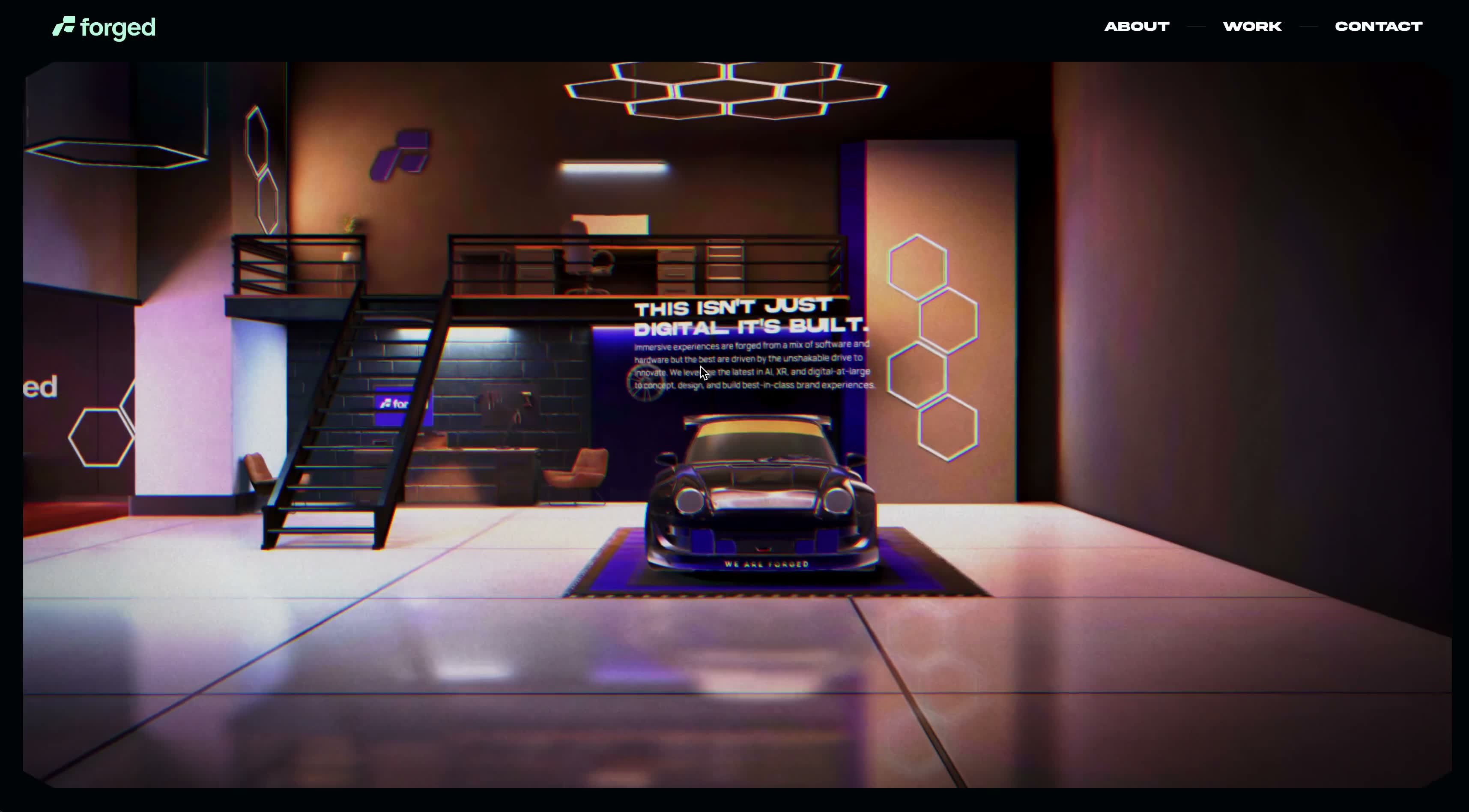
Forged.build
Forged.build turns a studio site into a cinematic 3D workshop built in WebGPU. Scroll through a real-time space with baked GI, dynamic highlights, and custom shaders. Built by Michael Modena to show what a small team can do with modern web graphics.
- Showcase
Noomo's 3D Storytelling Site: A Walk Through Phoenix
Noomo's storytelling site turns five client stories into rooms in a lit hallway, with animation bound to scroll instead of autoplay. Three.js doing the heavy lifting, WebGPU peeking around the corner on sister projects. Worth opening the network tab for.
- Showcase
Vermeer's Milkmaid Dissolved into WebGPU Particles
Revelium Studio broke Vermeer's 1658 Milkmaid into thousands of GPU-driven particles using WebGPU and Three.js TSL. Color-sampled from the original painting, the result is a particle cloud that somehow still holds the composition together. Worth a long stare.
- Showcase
WebHeat: GPU-Powered Thermal Simulation for Any STL File
A high school senior learned Newton's law of cooling in class, then built a full thermal simulation in the browser. Drop in any STL, watch heat propagate through voxelized geometry on the GPU. WebGPU compute shaders, React frontend, and a useRef trick that keeps it all from falling apart.
- Showcase
Grenzwert: Path-Traced Volumetric CT Rendering in WebGPU
Grenzwert renders volumetric CT data with ground-truth path tracing, right in your browser. Built on C++/WebAssembly with WebGPU, it streams a 3D mip pyramid for responsive interaction while you edit transfer functions and crop into the volume in real time.
- Showcase
Deferred Rendering in WebGPU: Sponza with 400+ Compute-Driven Point Lights
Georgi Nikolov's WebGPU renderer puts 400+ point lights in the classic Sponza atrium. Deferred shading, cascaded shadows, Hi-Z reflections, TAA. Clean architecture that handles WebGPU's explicit pipelines without drama.
- Showcase
Indra's Pearls
A WebGPU deep dive into Indra’s Pearls, where circle inversions and Möbius transforms turn math into living geometry.