Search the archive.
Find published work and reporting by title, description, article text or tag.
Refine results1
Also searching for Maps & Geography, because “map” is another name for it.
8 results for “map”.
- Showcase
San Rita: A Studio Site Disguised as a Topographic Map
San Rita ditches the agency portfolio grid for something stranger: a navigable topographic landscape where projects sit like waypoints on a trail system. Some paths are open, some are closed for restoration. It's weird, deliberate, and worth inspecting.
- Showcase
In The Clouds: Tallest Buildings as 40-Meter Blocks
The world's tallest buildings rendered as stacked 40-meter blocks in Three.js. One block equals four floors. Pure client-side WebGL with procedural geometry. No map tiles, just height data and math.
- Showcase
Google's Language Explorer
Explore 7,000+ languages on a slick WebGL-powered globe built by Google Research. Real-time filters, rich metadata, and interactive pins all driven by the LinguaMeta dataset.
- Showcase
Holiday Snow Globe
Michael Modena's holiday snow globe uses WebGPU compute shaders to create volumetric snow that actually fills the dome with mesh-based particles generating proper normals. Plus a Porsche GT3 drifts inside. It's a Christmas card that doubles as a lighting and compute shader stress test.
- Showcase
Martin Laxenaire's Portfolio Is a WebGPU Game Built on His Own Engine
Martin Laxenaire turned his portfolio into a playable WebGPU experience powered by gpu-curtains, his own 3D engine. Procedural particles, boids, and invoice-sized spheres unlock as you interact. Full source code and a Codrops breakdown included.
- Showcase
PLAIN: Generate Low-Poly 3D Terrain Graphics in Your Browser
PLAIN creates low-poly 3D plane graphics using vertex geometry and simplex noise. Displace a grid into terrain. Animate the surface. Control camera, color, shape. Export stills or loops. Built in p5.js.
- Showcase
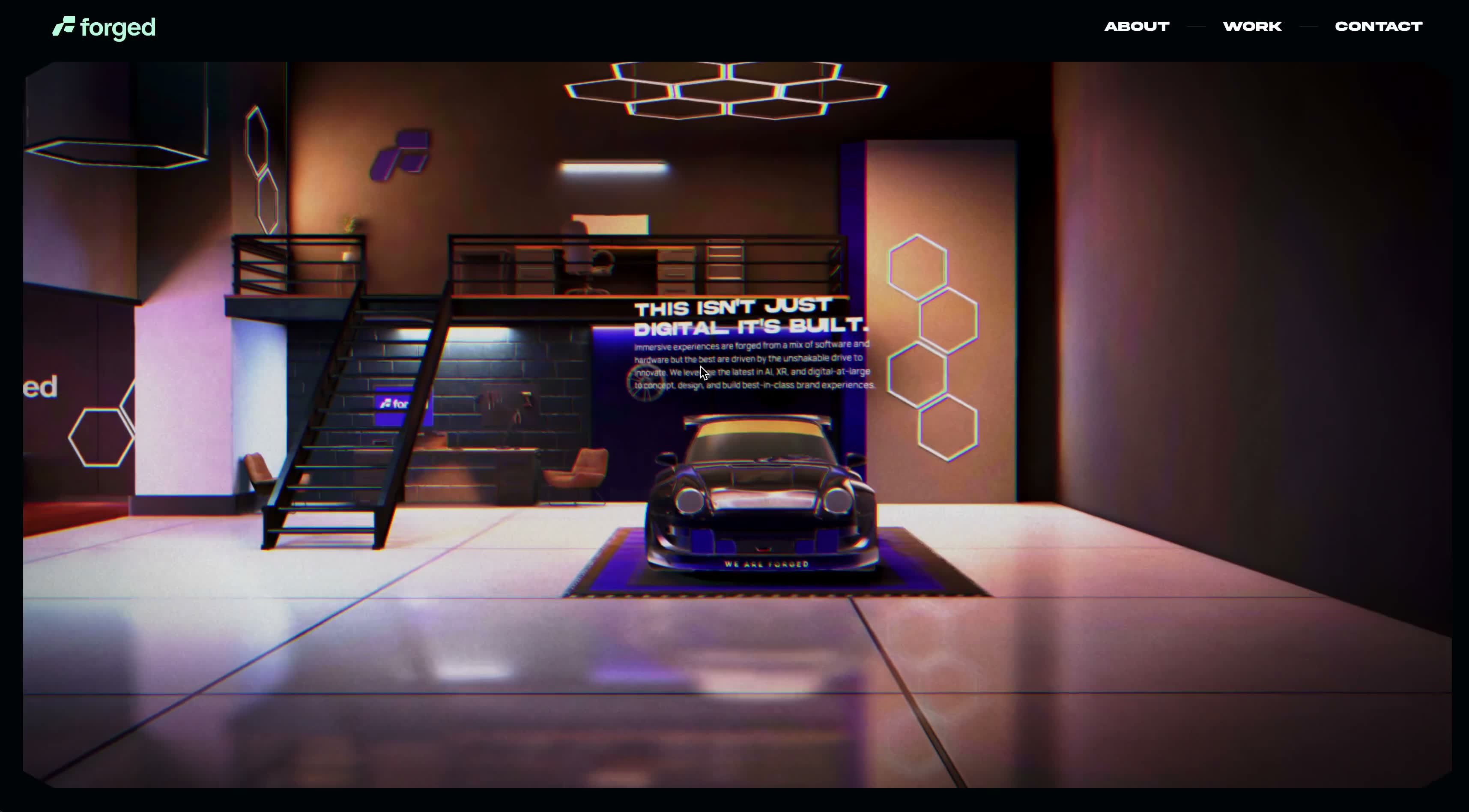
Forged.build
Forged.build turns a studio site into a cinematic 3D workshop built in WebGPU. Scroll through a real-time space with baked GI, dynamic highlights, and custom shaders. Built by Michael Modena to show what a small team can do with modern web graphics.
- Showcase
Find Your Way to Oz: The 2013 Chrome Experiment
UNIT9 built a full Kansas carnival in WebGL for Disney, then destroyed it with a tornado shader borrowed from neuroscience. No physics engine. No framework. Just clever faking, spatial audio, and a three-month deadline. The source is open.