Search the archive.
Find published work and reporting by title, description, article text or tag.
Refine results2
Also searching for Browser Support, because “browsers” is another name for it.
18 results for “browsers”.
- News
WebGPU Hits Critical Mass: All Major Browsers Now Ship It
Chrome, Firefox, Safari, and Edge all ship WebGPU by default. Eight years of spec work finally pays off. Here is what changed, where the gaps remain, and why this matters for graphics and compute on the web.
- Showcase
Realistic Physics Simulations in the Browser
Dive into saharan's impressive collection of browser-based physics simulations featuring realistic water droplets with WebAssembly SIMD, GPGPU-powered fluffy balls, coupled cloth-fluid dynamics, and more. All built with Haxe and open-sourced on GitHub for anyone curious about computational physics.
- Showcase
SuperSplat: Editing 3D Gaussian Splats in the Browser
A few million ellipsoids that snap into a photoreal coffee shop, an ant, the Moon. SuperSplat is a browser-based editor for cleaning up 3D Gaussian splats, with GPU-accelerated selection, unlimited undo, and a streamed LOD format for massive scenes. Open source, nothing to install.
- Showcase
Embedding Atlas: Apple's Open-Source Tool for Exploring Millions of Vectors in Your Browser
Apple's Embedding Atlas renders millions of embedding points interactively using WebGPU (with WebGL 2 fallback), Wasm-compiled UMAP, and density-based clustering that runs in milliseconds. Open source, with React, Svelte, Jupyter, and CLI support.
- Showcase
Ameen Abdullah's Portfolio Turns the Browser Into a Stage
A WebGPU sakura scene anchors the hero, Vue drives the page, and a second WebGL layer paints mini scenes into textures aligned with the DOM. Off-screen blocks pause their work. Subtitles arrive in Japanese. A portfolio that behaves like a place rather than a CV.
- Showcase
Marble Madness-Inspired Game for Netlify
Paris studio Little Workshop built a Marble Madness-inspired WebGL experience to celebrate Netlify's 5 million developers. Using Three.js, Rapier physics, and a Unity-to-browser pipeline, two devs created this award-winning browser game in 8 weeks.
- Showcase
Singularity: A Black Hole Simulation
A fully raymarched black hole in your browser (glowing accretion disk, gravitational lensing, radiation noise) all built with Three.js, TSL, and WebGPU. No geometry, just math. A cosmic shader experiment pushing real-time web graphics to the edge.
- Showcase
Gauzilla Pro: Web-Native Gaussian Splatting for 4D Digital Twins
A browser-based platform turning drone footage and smartphone video into photorealistic 3D scenes with AI-powered segmentation. Built on an open-source Rust/WASM renderer, no installs required. Construction teams are already using it for as-built documentation.
- News
glTF 2.1 Aims At Complex Scenes, Not Just Single Assets
Khronos is planning glTF 2.1 as a backward-compatible update focused on large composed scenes, external assets, packaging, BVHs, thumbnails, and 64-bit GLB files.
- Showcase
WebGPU Water Simulation: Porting a Piece of Graphics History
The 2011 demo that helped inspire Figma gets a WebGPU rewrite. Ripples, caustics, raytraced reflections, and a bobbing sphere, all running on modern GPU APIs. Yong Su's port is a case study in what it takes to cross the WebGL-to-WebGPU bridge.
- Showcase
spark.js GLTF Demo: Real-Time Texture Transcoding for Faster Asset Delivery
A GLTF viewer that ships textures as compact WebP or AVIF, then transcodes them to GPU-compressed formats in the browser. Small downloads, efficient VRAM. Spark.js handles the conversion so you get the best of both worlds.
- Showcase
Prinzipiell Tinker Series
Frank Reitberger’s Tinker series is a collection of WebGL and WebGPU experiments exploring procedural geometry, modular shaders, and real-time rendering in the browser. Each project builds on the last, offering sharp techniques and inspiration for anyone working with Three.js or TSL.
- Showcase
A Portfolio You Walk Through: Hot Dogtor's WebGPU Building
Paulo Pinho built his portfolio as a 3D building you wander room by room, scored by his own music. Runs on three.js WebGPU, falls back to WebGL, and ships a Basic version for everyone else. One site, three fidelity tiers, no pretending everyone's on a 4090.
- Showcase
A 9k Forest: Node-Based 3D Assets in WebGPU
Sedon wires a node graph into a real-time WebGPU renderer to grow a whole forest from about 9k of data. Rayleigh skies, rippling water, runtime LOD terrain, and a saved scene that fits in a URL. The twist: nearly every shader and pipeline was vibe coded, no engine involved.
- News
Google Introduces HTML-in-Canvas API: Accessible UI Meets WebGL / WebGPU
At Google I/O 2026, Chrome engineer Thomas Nattestad unveiled the HTML-in-Canvas API, which is a new web platform feature that lets developers render HTML elements directly into canvas, WebGL, and WebGPU contexts while preserving accessibility and interactivity.
- Showcase
SWOOOP: Low-Poly Biplane Flight in PlayCanvas
A low-poly biplane circles a floating island, collecting gems while physics and ambient occlusion do the heavy lifting. Built in WebGL with PlayCanvas in just four weeks by a remote team across Athens and London.
- Showcase
3D Math Playground
A 3D Math Playground for visual learners, built during a Bolt hackathon. Explore gradient descent, loss curves, and more, all vibe coded and rendered in real time.
- Showcase
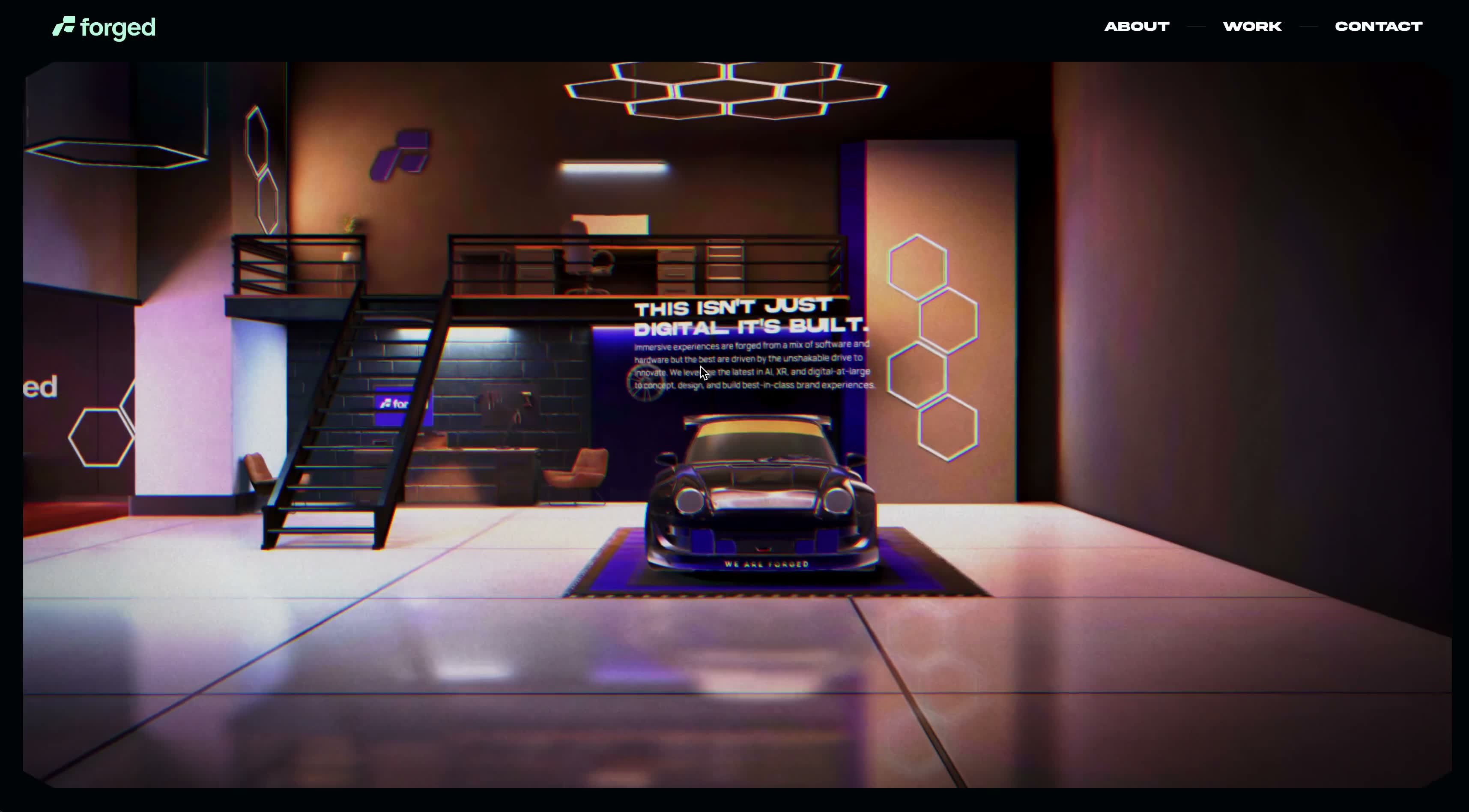
Forged.build
Forged.build turns a studio site into a cinematic 3D workshop built in WebGPU. Scroll through a real-time space with baked GI, dynamic highlights, and custom shaders. Built by Michael Modena to show what a small team can do with modern web graphics.