Search the archive.
Find published work and reporting by title, description, article text or tag.
Refine results2
Also searching for Browser Support, because “browsers” is another name for it.
24 results for “browsers”.

Real-Time Naval Combat in the Browser with Rust, WASM, and WebGL
Multiplayer warship battles running entirely in WebGL. 43 ships, torpedoes, submarines, aircraft carriers, and a custom Rust-to-WASM engine. No install. Just water and explosions. Open source.
Ranked results
- Showcase
Hydra: A Livecoded Video Synth Built on WebGL Framebuffers
Olivia Jack's Hydra turns the browser into a modular video synth. Chain oscillators, kaleidoscopes, and webcam feeds into recursive GLSL patches, then pipe the output to another browser over WebRTC. Type a function, hit Ctrl+Enter, watch the pixels misbehave.
- Showcase
Igloo Inc: Crystal Growth Algorithms, Shader-Driven UI, and Volume Data
Abeto built the Igloo Inc site entirely in WebGL, from procedurally grown ice crystals to shader-driven UI text. The particle footer alone, powered by custom VDB-to-browser volume data, is worth the scroll.
- Showcase
Laser Drift: A Synthwave Arcade Shooter Built in Three.js
Lowpoly spacecraft, neon grids, and custom shaders combine in this browser-based arcade game. Gesture controls on mobile, no UI clutter, and a commitment to retro aesthetics that goes deeper than a bloom filter.
- Showcase
Medusae: A Soft Body Jellyfish Simulation
Medusae is a browser-native jellyfish built with Three.js, GLSL, and a lean constraint solver. Ash Weeks pairs fixed-timestep physics with GPU interpolation and audio-reactive shaders to deliver lifelike, 60-fps motion.
- Showcase
Kiomet: A Real-Time Multiplayer Strategy Game Built With Rust and WebGL
Kiomet drops you into a live hex-grid battlefield with dozens of players, 27 tower types, and zero installs. The whole stack is Rust compiled to WebAssembly, rendered through WebGL with custom GLSL shaders. Open source and running in a browser tab.
- Showcase
A Windows 98 Portfolio
Evan Poliquin's portfolio renders a full Windows 98 desktop inside a three.js scene, with React UI nested via CSS3D and raycasting to translate 3D clicks into 2D interaction. Two versions ship: WebGL with metaballs, or video fallback for lower-spec machines.
- Showcase
Botanics: A Three.js Plant Study
Plantlike forms in a browser tab, no loops or cheap wiggle in sight. Sujen Phea's Three.js scene leans on instancing, careful shaders, and a scene budget that stays out of its own way. Open it, let it run, and see how long before you remember to close it.
- Showcase
Find Your Way to Oz: The 2013 Chrome Experiment
UNIT9 built a full Kansas carnival in WebGL for Disney, then destroyed it with a tornado shader borrowed from neuroscience. No physics engine. No framework. Just clever faking, spatial audio, and a three-month deadline. The source is open.
- Showcase
DRIFT: A Million Particles, a Lost Astronaut, and AI-Generated Loneliness
A lost astronaut records his diary in your browser. Over a million GPGPU particles shift with his mental state while AI generates fresh text and voice each visit. Ming Jyun Hung built something that feels alive and a little heartbreaking.
- Showcase
WebGPU Water Simulation: Porting a Piece of Graphics History
The 2011 demo that helped inspire Figma gets a WebGPU rewrite. Ripples, caustics, raytraced reflections, and a bobbing sphere, all running on modern GPU APIs. Yong Su's port is a case study in what it takes to cross the WebGL-to-WebGPU bridge.
- Showcase
WebGL Fluid Simulation by Pavel Dobryakov
A GPU-powered Navier-Stokes fluid solver running entirely in the browser. Swipe to create swirling, colorful flows with bloom effects, vorticity controls, and real-time interactivity. Works on mobile too.
- Showcase
Messenger
Messenger is a beautifully crafted WebGL delivery game. Set on a tiny cel-shaded planet, it runs flawlessly across browsers. Explore the charming world, complete deliveries, and discover hidden surprises.
- Showcase
CHILE20: Active Theory's Three-World WebGL Campaign for Adidas Originals
Active Theory built three scroll-driven WebGL worlds for adidas CHILE20, each with its own visual identity. 500K-poly garments baked down to mobile-friendly meshes, fluid cross-world transitions, and a lockdown-era campaign that still holds up.
- Showcase
Active Theory Portfolio
Active Theory's portfolio site is a technical flex: real-time particles, AI-powered navigation, and immersive 3D environments built on their custom Hydra framework. Twelve years of pushing browsers to their limits, and it shows.
- Showcase
Tendrils: Emergent WebGL Particle Visuals
Tendrils is a WebGL demo by Eoghan O’Keeffe that turns particles into living, fluid forms. Driven by GPU shaders and user input (audio, webcam, touch), it’s both interactive art and a tech deep-dive.
- Showcase
Prinzipiell Tinker Series
Frank Reitberger’s Tinker series is a collection of WebGL and WebGPU experiments exploring procedural geometry, modular shaders, and real-time rendering in the browser. Each project builds on the last, offering sharp techniques and inspiration for anyone working with Three.js or TSL.
- Showcase
img2threejs Turns One Photo Into Procedural Three.js Code
Hoài Nhớ's img2threejs rebuilds an object from one reference image as procedural, animation-ready Three.js code, with v1.3 improving geometry reconstruction and material generation.
- Showcase
Liminal Blends Two Paths Into One WebGL Visual
Manish Dhaka’s Liminal is a compact WebGL visual experiment about blending two different paths into a seamless shared transition.
- Showcase
A 9k Forest: Node-Based 3D Assets in WebGPU
Sedon wires a node graph into a real-time WebGPU renderer to grow a whole forest from about 9k of data. Rayleigh skies, rippling water, runtime LOD terrain, and a saved scene that fits in a URL. The twist: nearly every shader and pipeline was vibe coded, no engine involved.
- Showcase
BND Agency: An Agency Portfolio Built as a Showroom
Doan Bao Nam rebuilt the agency portfolio as a showroom you move through, not a page you scroll. Interactive 3D canvases and a custom audio-visual engine share a single frame, holding 60 FPS while sound and geometry run at once. Open devtools and watch how it stays steady.
- Showcase
Penderecki's Garden: A Point-Cloud Memorial Built Using Photogrammetry
Huncwot turned billions of drone-captured particles into a navigable WebGL garden for composer Krzysztof Penderecki. Custom GLSL shaders breathe with the music. Fully keyboard-accessible. One of the most ambitious Three.js projects we've seen.
- Showcase
San Rita: A Studio Site Disguised as a Topographic Map
San Rita ditches the agency portfolio grid for something stranger: a navigable topographic landscape where projects sit like waypoints on a trail system. Some paths are open, some are closed for restoration. It's weird, deliberate, and worth inspecting.
- Showcase
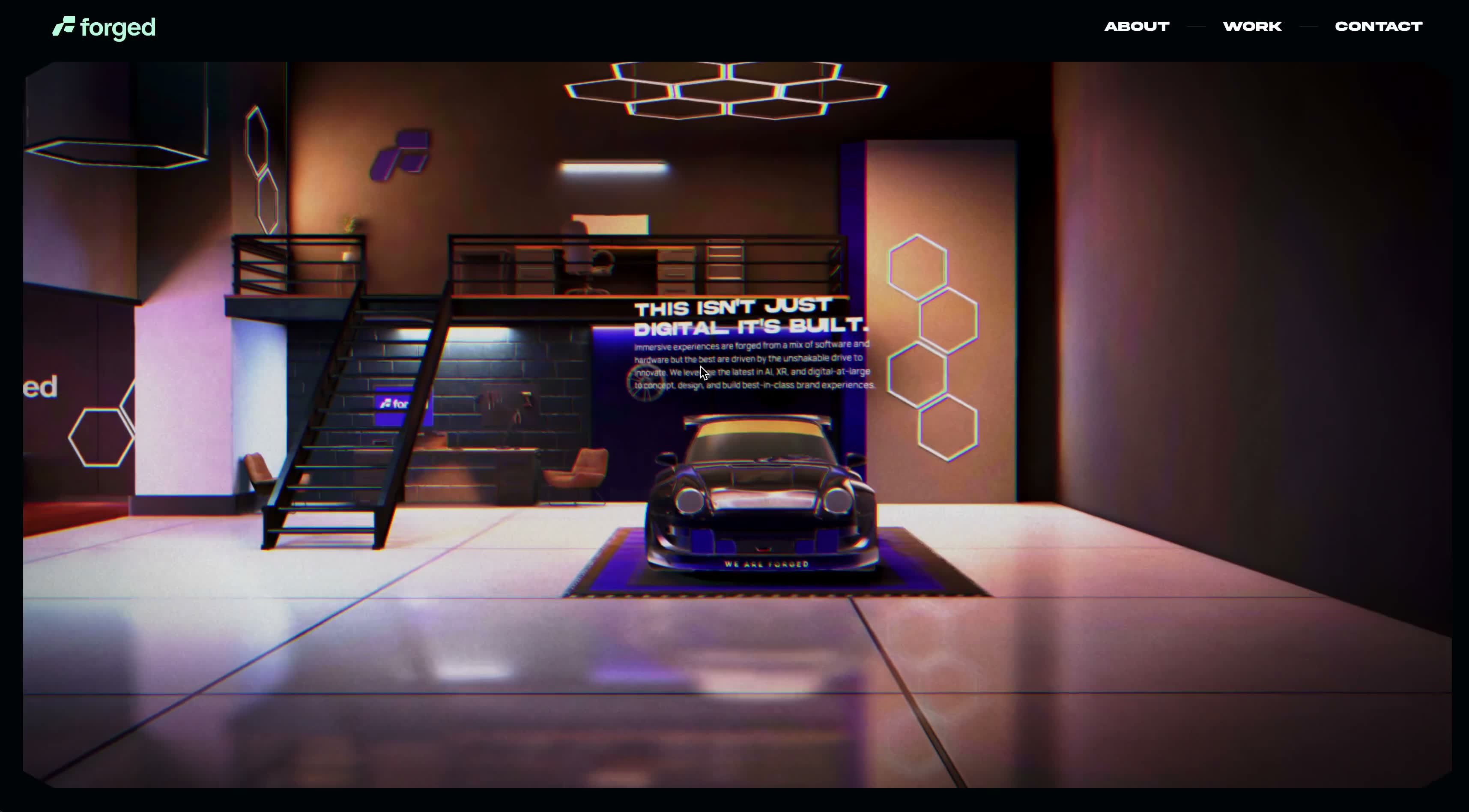
Forged.build
Forged.build turns a studio site into a cinematic 3D workshop built in WebGPU. Scroll through a real-time space with baked GI, dynamic highlights, and custom shaders. Built by Michael Modena to show what a small team can do with modern web graphics.