Search the archive.
Find published work and reporting by title, description, article text or tag.
Refine results
Also searching for Typography, because “text” is another name for it.
Results 25 to 48 of 65 for “text”.
- Showcase
Aurelia: Fully Procedural Jellyfish with WebGPU
A real-time procedural jellyfish built with Three.js WebGPURenderer. Bell contractions, verlet tentacles, and iridescent shaders are all generated on the fly in TSL. No baked textures, just pure GPU compute.
- Showcase
Giuseppe Paccione Turns a Portfolio Into a 3D Configurator
Giuseppe Paccione’s site is a real-time 3D interior portfolio-configurator with BIM, AI, authored textures, path tracing preview, LOD choices, and material controls.
- Showcase
Particles Cursor Turns Images Into a Shader Field
Gabriel Villanueva’s Three.js experiment turns images into particle grids that react to cursor movement through GLSL displacement, texture color, and real-time controls.
- Showcase
Semantic Globe: A WebGPU Earth That Understands Plain English
Type a vibe like "somewhere cold and lonely" and watch a 3D Earth pin the answer. The text embeddings and the planet shaders share one GPU in one browser tab, no server in the loop. Joshua Lochner's quiet flex of what WebGPU can do when nobody is looking.
- Showcase
Ad-Deir Monastery in WebGL: CyArk's Tapestry Takes You Inside Petra
CyArk's Tapestry rebuilds Petra's Ad-Deir Monastery from LiDAR and photogrammetry, then hands you the keys. A narrated seven-scene tour on a high-res textured mesh, with a free-explore mode sharing the same source of truth. Restrained engineering dressed up as a field trip.
- Showcase
LFM2-MoE: An 8.3B Parameter Language Model Running Entirely in Your Browser via WebGPU
Liquid AI's LFM2-MoE loads 8.3B parameters (1.5B active) and generates text client-side through WebGPU. No server, no API key. A hybrid convolution-attention architecture running Mixture-of-Experts inference in a browser tab, powered by Transformers.js.
- Showcase
DRIFT: A Million Particles, a Lost Astronaut, and AI-Generated Loneliness
A lost astronaut records his diary in your browser. Over a million GPGPU particles shift with his mental state while AI generates fresh text and voice each visit. Ming Jyun Hung built something that feels alive and a little heartbreaking.
- Showcase
San Rita: A Studio Site Disguised as a Topographic Map
San Rita ditches the agency portfolio grid for something stranger: a navigable topographic landscape where projects sit like waypoints on a trail system. Some paths are open, some are closed for restoration. It's weird, deliberate, and worth inspecting.
- Showcase
UNESCO's Virtual Museum of Stolen Artifacts, Rebuilt in 3D with NanoGL
A WebGL museum you weren't expecting to need. makemepulse rebuilt 240+ looted artifacts in 3D using their in-house NanoGL framework and a generative AI pipeline that turns flat photos into textured models. Architect Francis Kéré designed the space. The subject matter does the rest.
- Showcase
Zenith Observation Studio: An Observatory You Visit Instead of Read
A WebGL site that treats deep space as a place, not a pitch. Stars hold steady, depth stacks behind depth, and lighting carries the identity that copy usually does. Tiny on text, enormous on atmosphere. Open it on a big screen and look before you click.
- Showcase
Omega Clearspace: Scroll-Driven Orbital Debris in Three.js
Immersive Garden built a scroll-driven WebGL experience that puts you in orbit alongside 36,500 pieces of space junk. Wireframe-to-render transitions, spatial audio, and a four-armed capture vessel that makes it feel like an elegant unfolding of a problem.
- Showcase
CHILE20: Active Theory's Three-World WebGL Campaign for Adidas Originals
Active Theory built three scroll-driven WebGL worlds for adidas CHILE20, each with its own visual identity. 500K-poly garments baked down to mobile-friendly meshes, fluid cross-world transitions, and a lockdown-era campaign that still holds up.
- Showcase
gpu-curtains: A WebGPU 3D Engine That Syncs Shaders to Your DOM
Martin Laxenaire rebuilt his DOM-to-shader library for WebGPU, and this time it's a full 3D engine. Lights, shadows, compute shaders, glTF support, and the same trick that made curtains.js useful: your HTML elements become shader geometry that scrolls and resizes like native DOM.
- Showcase
WebHeat: GPU-Powered Thermal Simulation for Any STL File
A high school senior learned Newton's law of cooling in class, then built a full thermal simulation in the browser. Drop in any STL, watch heat propagate through voxelized geometry on the GPU. WebGPU compute shaders, React frontend, and a useRef trick that keeps it all from falling apart.
- Showcase
WebGPU Water Simulation: Porting a Piece of Graphics History
The 2011 demo that helped inspire Figma gets a WebGPU rewrite. Ripples, caustics, raytraced reflections, and a bobbing sphere, all running on modern GPU APIs. Yong Su's port is a case study in what it takes to cross the WebGL-to-WebGPU bridge.
- Showcase
The Spark: A Scroll-Driven WebGL Story That Runs Like a Short Film
A spark escapes into a city built to contain it. Scroll to push the story forward. cables.gl handles the 3D, Webflow stitches the UI, and the audio reacts to how fast you move. Projection mapping, CRT post-processing, and tight character animation make it feel like a game cutscene.
- Showcase
The Globe of Economic Complexity: Visualizing $15 Trillion in World Trade
Harvard's WebGL experiment animates 153,000 particles to map global exports. Each dot = $100M. Built with Three.js, it's a masterclass in data viz that's begging for a modern remake with up-to-date capabilities and data.
- Showcase
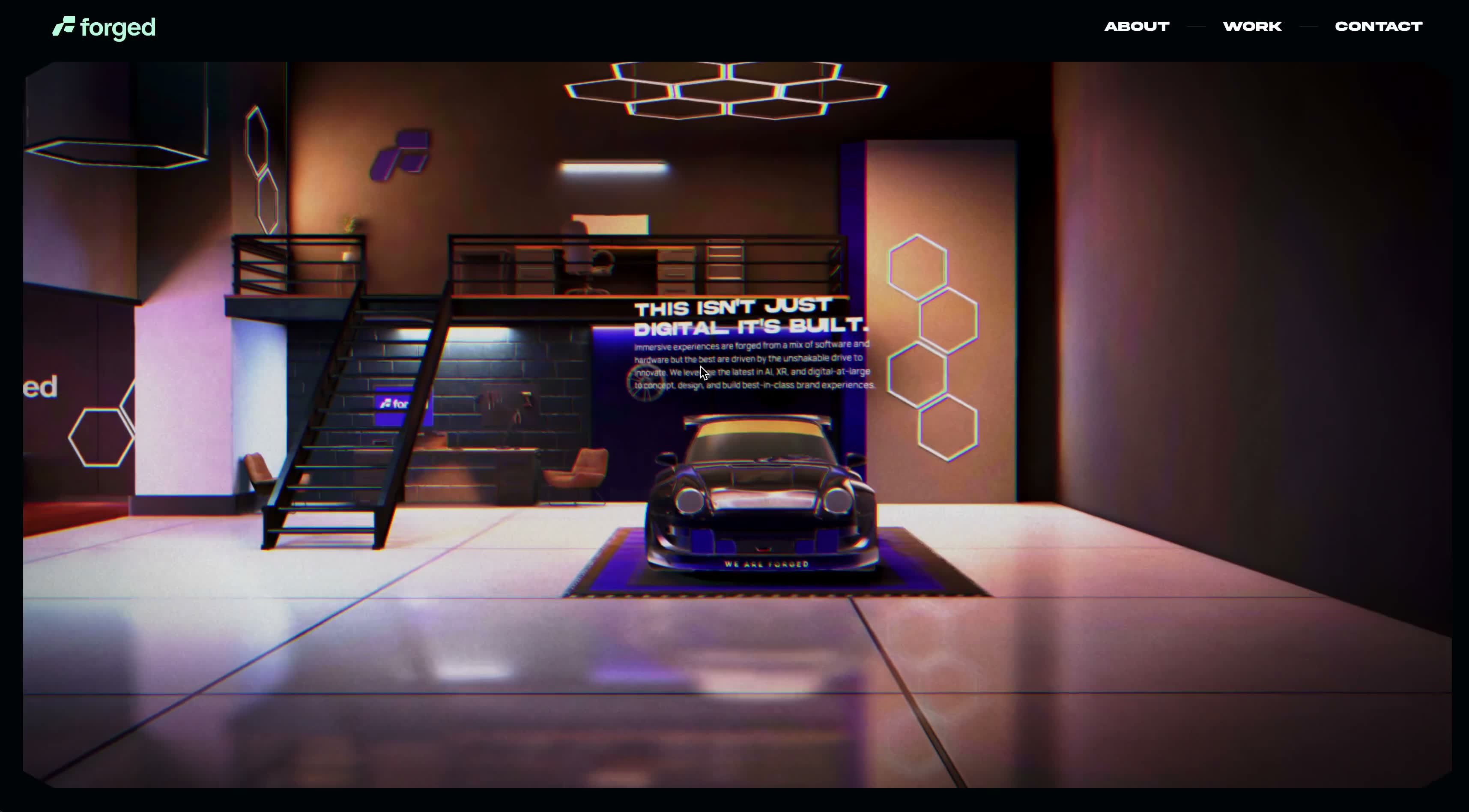
Forged.build
Forged.build turns a studio site into a cinematic 3D workshop built in WebGPU. Scroll through a real-time space with baked GI, dynamic highlights, and custom shaders. Built by Michael Modena to show what a small team can do with modern web graphics.
- Showcase
A Project Gallery That Bends Like Film
A row of project cards behaves like a strip of film you can scroll, flex, and shove around with your cursor. Built in Three.js with hand-written GLSL, where scroll velocity drives a vertex-shader bend and a post-process pass adds the grainy, almost celluloid edge shimmer.
- Showcase
Gaussian Splats on a Revit Model in 600 Lines of JavaScript
Michael Beale's gaussian-splats-lmv overlays photoreal XGRIDS captures onto a Revit model inside the APS Viewer. Same camera, same section planes. Three modules, roughly 600 lines of JS, a 65,536-bucket counting sort in a Web Worker, and 32-byte splat records doing the heavy lifting.
- Showcase
Patina Preview: Real-Time Procedural Weathering in Three.js and TSL
A small procedural PBR playground by codetaur where metal ages in real time. Oxidation pools in the cavities, highlights dull from mirror to milk, and the whole surface rewrites itself through a Three.js TSL node graph running on WebGPU.
- Showcase
Chessmate: A 3D Chess Game With Your Opponent's Face On The Board
A three.js chessboard wired to a WebRTC video call, so you can watch your friend squint before they blunder a rook. Same data channel carries the moves and the stream. No game server, just a link, a board, and the small tells chess has been missing online.
- Showcase
Justine Soulié's Portfolio: A WebGL Site Where Illustrations Are the Interface
Every illustration on Justine Soulié's portfolio is a live WebGL scene with its own micro-interactions. Built by Patrick Heng using OGL, scroll physics, and custom shaders, the canvas isn't decoration. It is the UI.
- Showcase
Mapillary: A Street View Stitched Together by Strangers
Hundreds of millions of crowdsourced street photos, blended into a navigable 3D world you can pan through like a panorama. Built on mapillary-js, an open source TypeScript and WebGL library by Oscar Lorentzon. Point clouds, undistorted camera frames, and an S2-cell navigation graph under the hood.