Search the archive.
Find published work and reporting by title, description, article text or tag.
Refine results
Also searching for Space, because “rocket” is another name for it.
Results 25 to 48 of 56 for “rocket”.
- Showcase
MONTREAL: A Snowy Owl Guides You Through a Hand-Illustrated WebGL City
Leeroy's MONTREAL is a WebGL experience where a snowy owl walks you through nine illustrated landmarks. Built with Three.js, Angular, GSAP, and Lottie, it layers hand-drawn art into 3D space with the feel of a storybook that learned how to breathe.
- Showcase
UNESCO's Virtual Museum of Stolen Artifacts, Rebuilt in 3D with NanoGL
A WebGL museum you weren't expecting to need. makemepulse rebuilt 240+ looted artifacts in 3D using their in-house NanoGL framework and a generative AI pipeline that turns flat photos into textured models. Architect Francis Kéré designed the space. The subject matter does the rest.
- Showcase
Mapillary: A Street View Stitched Together by Strangers
Hundreds of millions of crowdsourced street photos, blended into a navigable 3D world you can pan through like a panorama. Built on mapillary-js, an open source TypeScript and WebGL library by Oscar Lorentzon. Point clouds, undistorted camera frames, and an S2-cell navigation graph under the hood.
- Showcase
LFM2-MoE: An 8.3B Parameter Language Model Running Entirely in Your Browser via WebGPU
Liquid AI's LFM2-MoE loads 8.3B parameters (1.5B active) and generates text client-side through WebGPU. No server, no API key. A hybrid convolution-attention architecture running Mixture-of-Experts inference in a browser tab, powered by Transformers.js.
- Showcase
Orbiting a Single Photo: 3D Camera Control with Qwen Image Edit and Three.js
Upload a photo, drag a Three.js camera to a new angle, and a diffusion model hallucinates what the scene looks like from there. 96 poses, trained on Gaussian Splatting renders, running in a single app.py.
- Showcase
WebHeat: GPU-Powered Thermal Simulation for Any STL File
A high school senior learned Newton's law of cooling in class, then built a full thermal simulation in the browser. Drop in any STL, watch heat propagate through voxelized geometry on the GPU. WebGPU compute shaders, React frontend, and a useRef trick that keeps it all from falling apart.
- Showcase
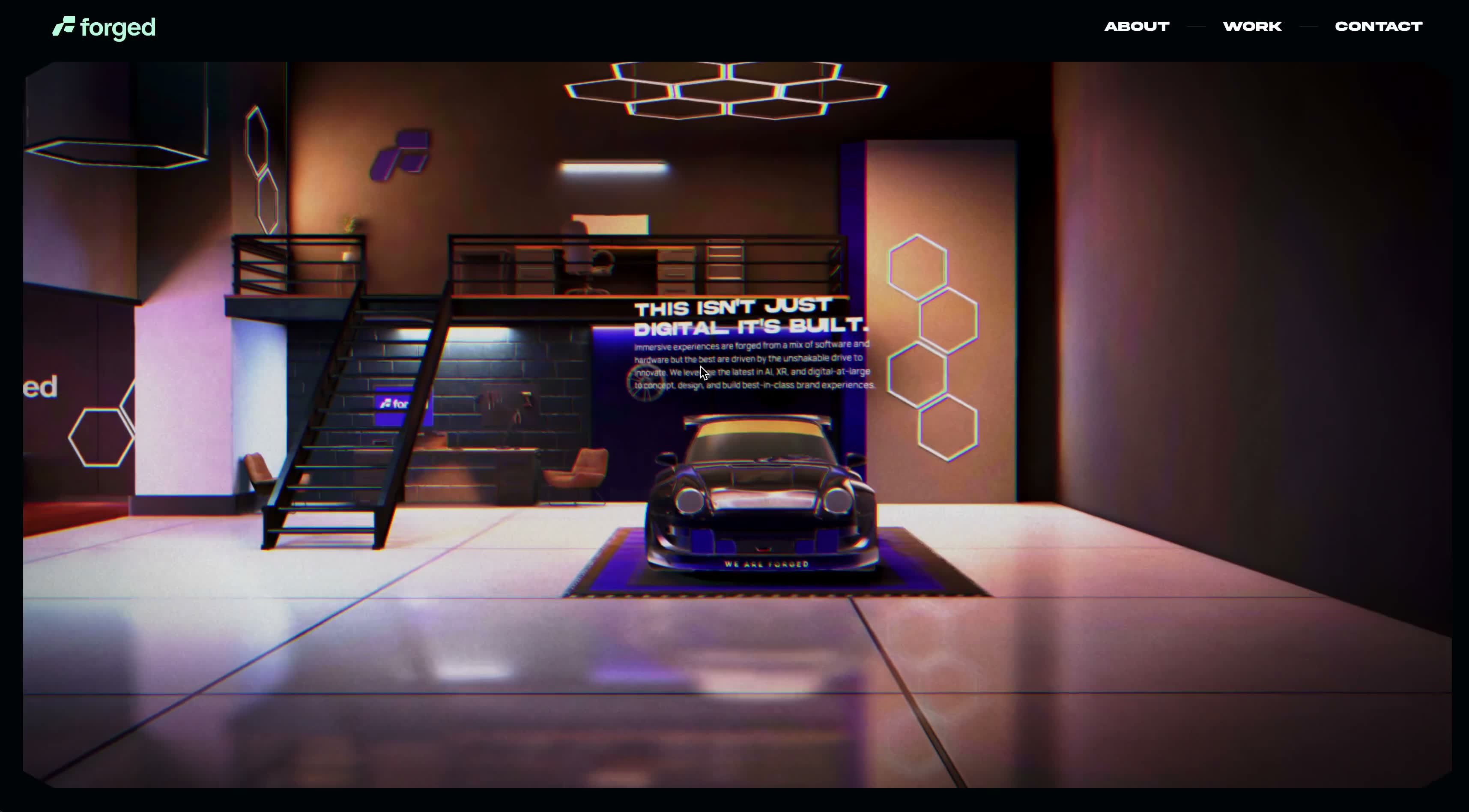
Forged.build
Forged.build turns a studio site into a cinematic 3D workshop built in WebGPU. Scroll through a real-time space with baked GI, dynamic highlights, and custom shaders. Built by Michael Modena to show what a small team can do with modern web graphics.
- Showcase
WebGPU Cluster Turns Browsers Into AI Inference Nodes
Alexsandro Souza’s WebGPU Cluster turns browser tabs into shared AI inference nodes, with WebGPU hosts running RF-DETR or SmolVLM behind a simple HTTP API.
- Showcase
Where Worlds Take Shape Makes a Portfolio Playable
Jérôme Reynet turns a portfolio into a playable WebGL world, with procedural grass, mini-games, gamepad controls, and project discovery that behaves more like exploration than navigation.
- Showcase
Totem.earth Turns a Web3 Landing Page Into a WebGL Ritual Object
OFF+BRAND’s Totem.earth wraps a Web3 ecosystem in smoke, light, and a draggable Three.js object that does most of the branding before the copy gets a turn.
- Showcase
A Project Gallery That Bends Like Film
A row of project cards behaves like a strip of film you can scroll, flex, and shove around with your cursor. Built in Three.js with hand-written GLSL, where scroll velocity drives a vertex-shader bend and a post-process pass adds the grainy, almost celluloid edge shimmer.
- Showcase
Evian's Bicentennial WebGPU World, Where Rain Runs Downhill
Evian's 200th turned into an alpine scene that hands everything to the GPU: rain that lands on peaks and streaks down the slopes, one wind texture every object obeys, lightning generated fresh on each strike, and 20,000 particles colliding against an SDF instead of meshes.
- Showcase
GRAIR: A Luxury Jewelry Site That Refuses to Sell You Anything
A jewelry concept with no grid, no cart, no product shots. Just a slow descent through purple shadow toward one diamond, built in Three.js and Blender where lighting does the work geometry usually does. Scroll becomes a camera. Mood becomes the interface.
- Showcase
BND Agency: An Agency Portfolio Built as a Showroom
Doan Bao Nam rebuilt the agency portfolio as a showroom you move through, not a page you scroll. Interactive 3D canvases and a custom audio-visual engine share a single frame, holding 60 FPS while sound and geometry run at once. Open devtools and watch how it stays steady.
- Showcase
Gaussian Splats on a Revit Model in 600 Lines of JavaScript
Michael Beale's gaussian-splats-lmv overlays photoreal XGRIDS captures onto a Revit model inside the APS Viewer. Same camera, same section planes. Three modules, roughly 600 lines of JS, a 65,536-bucket counting sort in a Web Worker, and 32-byte splat records doing the heavy lifting.
- Showcase
Walkable Gaussian Splat: Exploring the Duomo di Lecce with Reactylon and Babylon.js
A 6-minute GoPro video becomes a 32 MB navigable Gaussian Splat of a Baroque cathedral in Lecce, Italy. Built with Reactylon, a React renderer for Babylon.js, the fully local pipeline needs no cloud services. Walk through it with your arrow keys.
- Showcase
Scroll-Driven 3D Cargo Bike Configurator Built with Blender and Webflow
A cargo bike configurator where scrolling is the entire interface. Blender geometry piped into Webflow with scroll-triggered animations handling component swaps, color changes, and camera moves. No buttons, no menus. You scroll, the bike answers.
- Showcase
Interactive 3D Sony Headphones Built with Spline and Webflow
Lorenz Wieseke built a product page that actually earns your attention. Particle environments, animated audio wave rings, swappable colors, and convincing materials, all orchestrated through Spline and Webflow without a custom WebGL pipeline in sight.
- Showcase
Embedding Atlas: Apple's Open-Source Tool for Exploring Millions of Vectors in Your Browser
Apple's Embedding Atlas renders millions of embedding points interactively using WebGPU (with WebGL 2 fallback), Wasm-compiled UMAP, and density-based clustering that runs in milliseconds. Open source, with React, Svelte, Jupyter, and CLI support.
- Showcase
In The Clouds: Tallest Buildings as 40-Meter Blocks
The world's tallest buildings rendered as stacked 40-meter blocks in Three.js. One block equals four floors. Pure client-side WebGL with procedural geometry. No map tiles, just height data and math.
- Showcase
Škoda Vision Concept: Automotive-Grade 3D in the Browser
Bao Nam Doan built a real-time 3D Škoda concept car viewer that looks like it belongs in a design studio, not a browser tab. React Three Fiber, WebGL, and the kind of lighting that makes you forget you're on the web.
- Showcase
Erfan Mirasadi's Three.js Portfolio with Theatre.js Choreography
A 3D interactive portfolio built with Three.js, Theatre.js, and Next.js that actually runs smoothly on mobile. Draco compression keeps geometry lean, code-splitting prevents bundle bloat, and touch controls work like they should.
- Showcase
Game of 3D Life: Conway's Cellular Automaton with WebGPU
Conway's Game of Life in three dimensions. Simulation and rendering both run on the GPU via WebGPU compute shaders. No frameworks, just vanilla JS and hundreds of thousands of instanced cubes. Fly through the clusters as they evolve.
- Showcase
WebGPU Water Simulation: Porting a Piece of Graphics History
The 2011 demo that helped inspire Figma gets a WebGPU rewrite. Ripples, caustics, raytraced reflections, and a bobbing sphere, all running on modern GPU APIs. Yong Su's port is a case study in what it takes to cross the WebGL-to-WebGPU bridge.