Search the archive.
Find published work and reporting by title, description, article text or tag.
Refine results1
Results 25 to 48 of 59 for “Three.js”.
- Showcase
Shader.se: An 80s Corporate Tape Rendered in WebGPU
A Swedish studio's landing page done up like a 1987 training reel, with chunky type and confident geometry giving way to scene transitions that only make sense on a modern GPU. Built with Three.js on WebGPU and shaded with TSL.
- Showcase
Softbody Tetris: A Squishy WebGPU Remake That Plays Different
Niklas Niehus rebuilt Tetris with soft body physics running entirely on WebGPU via Three.js TSL. Blocks deform on impact, wedge into gaps, and create emergent gameplay the original never had. Fully playable in your browser.
- Showcase
Penderecki's Garden: A Point-Cloud Memorial Built Using Photogrammetry
Huncwot turned billions of drone-captured particles into a navigable WebGL garden for composer Krzysztof Penderecki. Custom GLSL shaders breathe with the music. Fully keyboard-accessible. One of the most ambitious Three.js projects we've seen.
- Showcase
Earthquake Pulse Map: A Century of Seismic Activity on a WebGL Globe
A Three.js globe plotting 120+ years of major earthquakes with custom GLSL shaders, binary-packed data, and live USGS feeds. Spin, zoom, and scrub through time. The tectonic boundaries light up whether you're ready or not.
- Showcase
Molazone: A Rotating World Built Like a Vinyl Record for Yamê's Album
Studio 9P built Yamê's album site on a spinning disc in Three.js. The motorcycle stays still while Blender environments rotate underneath, cell-shaded to look like Moebius comic panels. There's even a mini-game hidden inside.
- Showcase
A Windows 98 Portfolio
Evan Poliquin's portfolio renders a full Windows 98 desktop inside a three.js scene, with React UI nested via CSS3D and raycasting to translate 3D clicks into 2D interaction. Two versions ship: WebGL with metaballs, or video fallback for lower-spec machines.
- Showcase
Orage Studio: A Modular WebGL Grid That Feels Like a Visual Operating System
Orage's homepage runs on a custom WebGL canvas-masking engine. Shader-driven tiles flicker and sync like data packets, the menu is drag-and-drop, and the whole thing boots like a terminal. Built by Beaucoup with Three.js, GSAP, and a deep commitment to the retro-tech aesthetic.
- Showcase
The Globe of Economic Complexity: Visualizing $15 Trillion in World Trade
Harvard's WebGL experiment animates 153,000 particles to map global exports. Each dot = $100M. Built with Three.js, it's a masterclass in data viz that's begging for a modern remake with up-to-date capabilities and data.
- Showcase
Prinzipiell Tinker Series
Frank Reitberger’s Tinker series is a collection of WebGL and WebGPU experiments exploring procedural geometry, modular shaders, and real-time rendering in the browser. Each project builds on the last, offering sharp techniques and inspiration for anyone working with Three.js or TSL.
- Showcase
CodeofSagar: 3D Animated Portfolio
Sagar Kumar Ghosh built a 3D portfolio that feels more like an interactive scene than a resume. It runs on React, Three.js, GSAP, and even dips into WebGPU. If you're curious how to blend real-time graphics with a modern web stack, this is worth a close look.
- Showcase
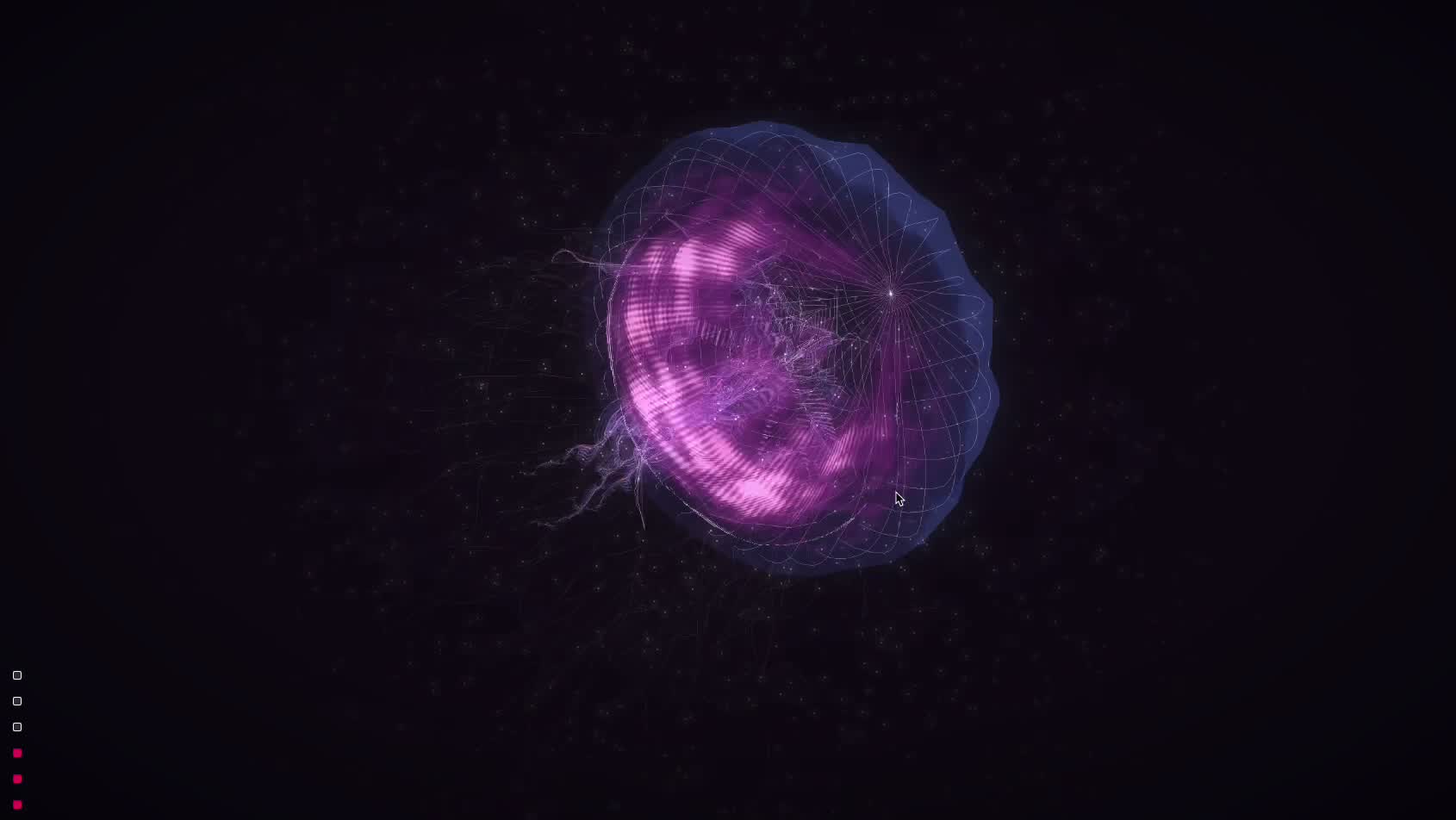
Medusae: A Soft Body Jellyfish Simulation
Medusae is a browser-native jellyfish built with Three.js, GLSL, and a lean constraint solver. Ash Weeks pairs fixed-timestep physics with GPU interpolation and audio-reactive shaders to deliver lifelike, 60-fps motion.
- Showcase
Interactive Physics With a TSL Fisheye Lens
Nikita Frolov combines physics-driven motion, glass refraction, iridescent metal, post FX, and a custom TSL fisheye node in a compact WebGPU experiment.
- Showcase
Above the Grassland Builds a Cinematic WebGPU Field
Ameen Abdullah’s Above the Grassland is a browser cinematic with WebGPU postprocessing, moving grass fields, weather presets, audio, narration, subtitles, and mood controls.
- Showcase
Semantic Globe: A WebGPU Earth That Understands Plain English
Type a vibe like "somewhere cold and lonely" and watch a 3D Earth pin the answer. The text embeddings and the planet shaders share one GPU in one browser tab, no server in the loop. Joshua Lochner's quiet flex of what WebGPU can do when nobody is looking.
- Showcase
DRIFT: A Million Particles, a Lost Astronaut, and AI-Generated Loneliness
A lost astronaut records his diary in your browser. Over a million GPGPU particles shift with his mental state while AI generates fresh text and voice each visit. Ming Jyun Hung built something that feels alive and a little heartbreaking.
- Showcase
Igloo Inc: Crystal Growth Algorithms, Shader-Driven UI, and Volume Data
Abeto built the Igloo Inc site entirely in WebGL, from procedurally grown ice crystals to shader-driven UI text. The particle footer alone, powered by custom VDB-to-browser volume data, is worth the scroll.
- Showcase
Skatebuilder: A 3D Skateboard Configurator
Paint directly onto a 3D skateboard, layer decals, and rotate to inspect your work. Built with React Three Fiber, Skatebuilder handles real-time brush strokes and texture compositing with the kind of polish most product configurators never achieve.
- Showcase
Studio Lumio: A Monochrome Portfolio
A designer-developer duo's portfolio that knows when to stop. Smooth GSAP transitions, cursor-reactive layouts, and shaders that punctuate rather than shout. Next.js, Lenis, Zustand, and an open-source hooks repo worth bookmarking.
- Showcase
Why Most 3D Websites Feel Wrong (and How to Fix It)
An interactive demo that breaks down what makes 3D sites feel clunky vs. alive. Step through real examples of inertia, bounce, magnetic snapping, and micro-interactions that transform flat 3D into something users actually want to touch.
- Showcase
Gen-02 Portfolio: An Immersive World
Samsy transforms the traditional portfolio into a 3D navigable space with his Gen-02 site. Built with Vue.js, GSAP, and custom WebGL, visitors explore interactive rooms showcasing a decade of award-winning creative tech work. Awwwards SOTD winner with serious technical depth.
- Showcase
Messenger
Messenger is a beautifully crafted WebGL delivery game. Set on a tiny cel-shaded planet, it runs flawlessly across browsers. Explore the charming world, complete deliveries, and discover hidden surprises.
- Showcase
The Monolith Project
The Monolith Project is a cinematic WebGL journey built with React Three Fiber. It weaves together modular shaders, layered particle systems, and a custom deferred renderer into a scroll-driven story that flows like a film. Every effect is modular. Every transition feels intentional.
- Showcase
3D Life Sim Turns Artificial Life Into a WebGPU Instrument
Aaron Lemke's 3D Life Sim is an open-source WebGPU particle life simulation with live audio input, MIDI mapping, presets, and cockpit controls for exploring emergent forms.
- Showcase
Shader Lab: Stack, Animate, and Export GPU Shaders in the Browser
A layered shader compositor that runs on WebGPU. Stack gradients, text, and TSL passes, then bend them through a CRT layer that models phosphor smear and channel convergence. Write shaders as node graphs, keyframe the knobs, and export the whole thing into React.